
Consumer Financial Protection Bureau’s Proposed Prepaid Card Regulatory Changes Inspires Industry Response

When the Consumer Financial Protection Bureau (CFPB) was created in 2010, nobody expected it to play nice with the financial services industry. Authorized as part of the Dodd-Frank legislation, the CFPB was tasked with protecting consumers from predatory lending and other Wall Street abuses that spawned the Great Recession. From the very start, the financial services industry and its allies in Congress resisted the formation of the CFPB, and even successfully torpedoed the choice of now-Senator Elizabeth Warren to lead the agency. Now, a new battle is about to commence: the CFPB is gunning for prepaid regulatory changes.


In the handful of years since the CFPB began its oversight of the financial services industry, it has scored a number of consumer-friendly victories. Largely unheralded by the media, the CFPB has managed to do everything from force credit card issuers to be more transparent about the interest charges related to balance transfers to handling hundreds of thousands of consumer complaints. Red Boxer (CFPB) Squares Off with Blue Boxer (NBPCA)More recently, the CFPB has placed the prepaid debit card industry in its crosshairs and, not coincidentally, triggered concern and angst from the Network Branded Prepaid Card Association (NBPCA), an industry trade group.

The proposals by the CFPB and the responses from the NBPCA are a classic illustration of the inherent adversarial relationship between regulators charged with protecting the interest of consumers and industry eager to help its businesses remain as profitable as possible. For example:

  • The CFPB would like to apply the more rigorous regulations that apply to credit cards to certain prepaid products, especially those that allow customers to overdraft or overdraw their accounts. This application of what is known as the Federal Reserve’s Regulation Z to certain prepaid cards is opposed by the NBPCA, which says it’s the sort of restrictive regulation that limits options for consumers and may even result in customers opting for riskier products.
  • The CFPB has proposed expanding the definition of what a prepaid debit card is, the result of which would be more an expansion of the number of products subject to government regulations. The NBPCA, by contrast, wants to limit the definition to only primary account transactions, which take the place of a debit card tied to a checking account.
  • There is some overlap in what the industry and the government want to see in the realm of disclosure about fees. Both the CFPB want more disclosure, though the industry group wants a single template for disclosure while the government has proposed a number of them.
  • Even the speed with which the government’s rules would go into effect is a matter of debate. The CFPB has said nine months is plenty of time for prepaid card issuers to adapt to the new rules while the NBPCA believes it will take between 18 and 24 months.

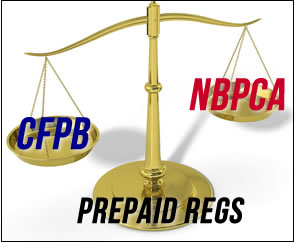
The final determination about the rules that will govern prepaid cards in the future is still being hashed out. Scales of Justice: CFPB vs NBPCAAnd while it would be easy to decry this sort of back-and-forth as yet another instance of Washington paralysis, there’s a case to be made that this process is working just as it should. No industry wants to bear the increased time and money it requires to comply with new rules and regulations, especially when it comes at the cost of profits. But this adversarial relationship between the prepaid industry and the CFPB could and should result in a range of protections that ensure consumers aren’t victimized. At the same time, the input of industry should ensure that whatever new regulations get enacted don’t drive the efficiency and consumer value out of prepaid debit cards.
If both happen, then consumers will have more confidence in prepaid cards generally, which is a win for both the CFPB and the NBPCA.



Category: Best Low Fee Prepaid Cards

Millions of people are turning to prepaid debit cards as a smart alternative to carrying cash and writing checks. Almost anyone can qualify and they don’t require a credit check or a bank account.

Though they carry credit card logos and can be used anywhere a credit card is used, unlike a credit card, they do not offer a line of credit. The user can only spend the amount that has been loaded onto the card or placed into the account associated with the card.

There are dozens of debit cards on the market, many of them issued by the same bank, but fee structures are vastly different. Bestprepaiddebitcards.com has done all the research for you and provides comprehensive reviews to help you decide which card is best for you.


GO2bank Offers Overdraft Protection up to $300.

And build your credit with the GO2bank Secured Visa® Credit Card with no annual fee*, no credit check*, and no impact to your credit when you apply. (sponsor link)


  • Consumer Financial Protection Bureau’s Proposed Prepaid Card Regulatory Changes Inspires Industry Response

    Consumer Financial Protection Bureau’s Proposed Prepaid Card Regulatory Changes Inspires Industry Response

    When the Consumer Financial Protection Bureau (CFPB) was created in 2010, nobody expected it to play nice with the financial services industry. Authorized as part of the Dodd-Frank legislation, the CFPB was tasked with protecting consumers from predatory lending and other Wall Street abuses that spawned the Great Recession. From the very start, the financial services industry and its allies in Congress resisted the formation of the CFPB, and even successfully torpedoed the choice of now-Senator Elizabeth Warren to lead the agency. Now, a new battle is about to commence: the CFPB is gunning for prepaid regulatory changes.


    In the handful of years since the CFPB began its oversight of the financial services industry, it has scored a number of consumer-friendly victories. Largely unheralded by the media, the CFPB has managed to do everything from force credit card issuers to be more transparent about the interest charges related to balance transfers to handling hundreds of thousands of consumer complaints. Red Boxer (CFPB) Squares Off with Blue Boxer (NBPCA)More recently, the CFPB has placed the prepaid debit card industry in its crosshairs and, not coincidentally, triggered concern and angst from the Network Branded Prepaid Card Association (NBPCA), an industry trade group.

    The proposals by the CFPB and the responses from the NBPCA are a classic illustration of the inherent adversarial relationship between regulators charged with protecting the interest of consumers and industry eager to help its businesses remain as profitable as possible. For example:

    • The CFPB would like to apply the more rigorous regulations that apply to credit cards to certain prepaid products, especially those that allow customers to overdraft or overdraw their accounts. This application of what is known as the Federal Reserve’s Regulation Z to certain prepaid cards is opposed by the NBPCA, which says it’s the sort of restrictive regulation that limits options for consumers and may even result in customers opting for riskier products.
    • The CFPB has proposed expanding the definition of what a prepaid debit card is, the result of which would be more an expansion of the number of products subject to government regulations. The NBPCA, by contrast, wants to limit the definition to only primary account transactions, which take the place of a debit card tied to a checking account.
    • There is some overlap in what the industry and the government want to see in the realm of disclosure about fees. Both the CFPB want more disclosure, though the industry group wants a single template for disclosure while the government has proposed a number of them.
    • Even the speed with which the government’s rules would go into effect is a matter of debate. The CFPB has said nine months is plenty of time for prepaid card issuers to adapt to the new rules while the NBPCA believes it will take between 18 and 24 months.

    The final determination about the rules that will govern prepaid cards in the future is still being hashed out. Scales of Justice: CFPB vs NBPCAAnd while it would be easy to decry this sort of back-and-forth as yet another instance of Washington paralysis, there’s a case to be made that this process is working just as it should. No industry wants to bear the increased time and money it requires to comply with new rules and regulations, especially when it comes at the cost of profits. But this adversarial relationship between the prepaid industry and the CFPB could and should result in a range of protections that ensure consumers aren’t victimized. At the same time, the input of industry should ensure that whatever new regulations get enacted don’t drive the efficiency and consumer value out of prepaid debit cards.

    If both happen, then consumers will have more confidence in prepaid cards generally, which is a win for both the CFPB and the NBPCA.


  • Consumer Alert!  New Credit Card Scam: Stealing Security Codes

    Consumer Alert! New Credit Card Scam: Stealing Security Codes

    This is a new credit card scam everyone needs to be watching out for. If you get a call from someone claiming to be from your bank, here’s what to do: If a caller claims to be from your card issuer’s fraud-prevention department, ask for the caller’s name and/or employee ID, hang up, then call the 800-number on the back of your card and ask to speak to the fraud-prevention department or that particular employee. If the call was not from the card issuer, explain that your account number likely has been stolen. The issuer will give you a new card with a new number.


    Here is a link to the full article originally posted in the July 15, 2015 edition of Bottom Line Personal as well as on their website at the link below.
    New Credit Card Scam: Stealing Security Codes
    http://bottomlinepersonal.com/new-credit-card-scam-stealing-security-codes/

Credit and Debit Card Ratings