
Employers Cannot Mandate Prepaid Cards For Wages

Responding to complaints, the Consumer Financial Protection Bureau (CFPB) issued a reminder to employees that they cannot force workers to accept pay on prepaid debit cards.

by Shane Tripcony

Over the summer the practice of using prepaid debit cards to pay employee salaries garnered a lot of attention, much of it negative. News outlets, The New York Times, Time Magazine and Businessweek, report that employees of large companies such as McDonald’s and Time Warner Cable complained that they were being forced to accept wages deposited onto a prepaid debit card. They were not offered the option of a paper check or direct deposit.

Employees, many of them earning minimum wage, argued that payment via prepaid debit card meant they were losing a chunk of their salary to a range of the standard fees associated with prepaid debit cards. In response to the outcry, New York Attorney General, Eric Schneiderman, launched an investigation into rules around the use of prepaid debit cards to pay salaries that were being broken. As part of that effort, Schneiderman requested information from 42 companies doing business in New York – including Sears, Home Depot and Walgreen’s – about their use of prepaid cards to meet payroll. “No worker should have to accept a form of payment that reduces take-home pay and leads to hundreds of dollars in fees,” Schneiderman told NBC News.

Now Schneiderman is receiving support from the federal government. Last month the Consumer Financial Protection Bureau (CFPB) issued a bulletin reminding employers that they cannot require employees to receive wages on a prepaid debit card. “Today’s release warns employers that they cannot mandate that their employees receive wages on a payroll card,” CFPB Director Rich Cordray said in a statement. “And for those employees who choose to receive wages on a payroll card, they are entitled to certain federal protections.

In its statement, the CFPB declared that the use of prepaid debit cards to pay wages falls under its jurisdiction under the Electronic Fund Transfer Act and Regulation E. These provisions outline a number of employee protections specific to prepaid debit cards. Among them are written disclosures of all fees related to the cards, access to account history and limited liability in the case of unauthorized use of a card.

In making its declaration concerning employers’ use of prepaid debit cards, the CFPB announced its intention to aggressively enforce the rules. “The Bureau intends to use its enforcement authority to stop violations before they grow into systemic problems, maximize remediation to consumers, and deter future violations,” reads a statement from the CFPB.

 

Tag: prepaid debit cards

  • Employers Cannot Mandate Prepaid Cards For Wages

    Employers Cannot Mandate Prepaid Cards For Wages

    Responding to complaints, the Consumer Financial Protection Bureau (CFPB) issued a reminder to employees that they cannot force workers to accept pay on prepaid debit cards.

    by Shane Tripcony

    Over the summer the practice of using prepaid debit cards to pay employee salaries garnered a lot of attention, much of it negative. News outlets, The New York Times, Time Magazine and Businessweek, report that employees of large companies such as McDonald’s and Time Warner Cable complained that they were being forced to accept wages deposited onto a prepaid debit card. They were not offered the option of a paper check or direct deposit.

    Employees, many of them earning minimum wage, argued that payment via prepaid debit card meant they were losing a chunk of their salary to a range of the standard fees associated with prepaid debit cards. In response to the outcry, New York Attorney General, Eric Schneiderman, launched an investigation into rules around the use of prepaid debit cards to pay salaries that were being broken. As part of that effort, Schneiderman requested information from 42 companies doing business in New York – including Sears, Home Depot and Walgreen’s – about their use of prepaid cards to meet payroll. “No worker should have to accept a form of payment that reduces take-home pay and leads to hundreds of dollars in fees,” Schneiderman told NBC News.

    Now Schneiderman is receiving support from the federal government. Last month the Consumer Financial Protection Bureau (CFPB) issued a bulletin reminding employers that they cannot require employees to receive wages on a prepaid debit card. “Today’s release warns employers that they cannot mandate that their employees receive wages on a payroll card,” CFPB Director Rich Cordray said in a statement. “And for those employees who choose to receive wages on a payroll card, they are entitled to certain federal protections.

    In its statement, the CFPB declared that the use of prepaid debit cards to pay wages falls under its jurisdiction under the Electronic Fund Transfer Act and Regulation E. These provisions outline a number of employee protections specific to prepaid debit cards. Among them are written disclosures of all fees related to the cards, access to account history and limited liability in the case of unauthorized use of a card.

    In making its declaration concerning employers’ use of prepaid debit cards, the CFPB announced its intention to aggressively enforce the rules. “The Bureau intends to use its enforcement authority to stop violations before they grow into systemic problems, maximize remediation to consumers, and deter future violations,” reads a statement from the CFPB.
     

  • Celebrity Prepaid Debit Card Smackdown 2013

    Celebrity Prepaid Debit Card Smackdown 2013

    Nobody would argue that hip-hop impresario Russell Simmons is anything but cool. After all, the guy was one of the forces behind Def Jam, the record label that brought us the Beastie Boys and LL Cool J. These days, Simmons is a business magnate whose net worth is estimated to be north of $300 million. And Simmons is looking to add to that sizable fortune by lending his name to a celebrity prepaid debit card called the RushCard. In doing so, Simmons joins personal finance guru Suze Orman and the increasingly notorious singer Justin Bieber in endorsing and promoting celebrity prepaid cards.

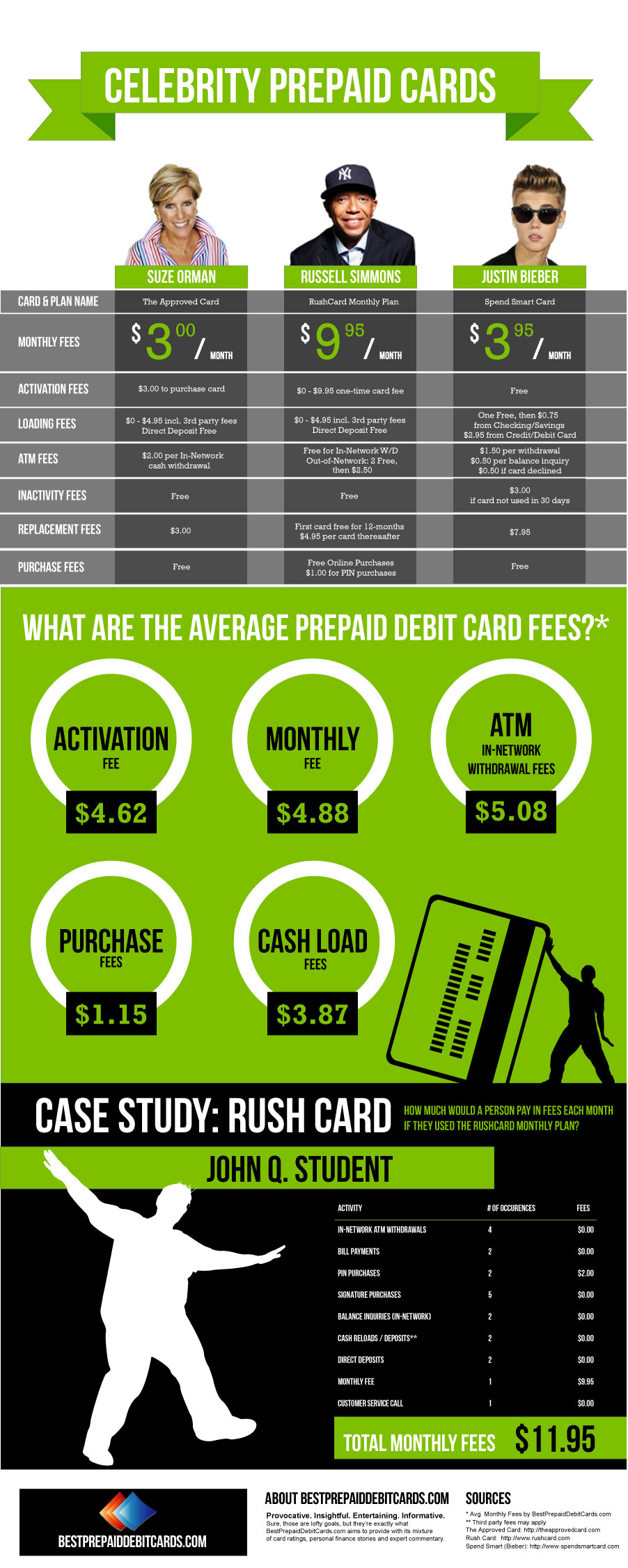
    An examination of the fees associated with these three celebrity prepaid cards by BestPrepaidDebitCards.com reveals that it can be a pricey proposition to use star-powered plastic, albeit not always more expensive than average prepaid debit card fees. For instance, while Orman and Bieber charge $3.00 and $3.95, respectively, in standard monthly fees, the tab for Simmons’ celebrity prepaid card is $9.95 – an amount that is more than $5.00 higher than the average monthly fee. To be fair, there are other Rush card offerings with lower monthly fees and may be found in free monthly fees for the Pay As You Go Plan to $5.95 or $7.95 on the Rush Unlimited Plan depending on your direct deposit status.

    In other areas, the fees charged on the celeb-backed cards are comparable, including similar charges for ATM transactions or for putting money into the account (known as loading fees). Consumers should note, however, that although an issuer may not charge a fee to load cash on their card, they may have to utilize third party services which do charge, such as Green Dot MoneyPak or MoneyGram, and fees can range from $3.74 to $4.95.

    An alternative product is Bluebird by American Express, which does not offer star-power, but it does offer great features and very low fees. Still, there’s no getting around the fact that there’s a premium to be paid for associating yourself with a celebrity card. In a hypothetical tally of fees from a month of modest usage of our sample RushCard plan, BestPrepaidDebitCards.com calculated that it would cost a cardholder around $12 per month. Is using a celebrity prepaid card really that cool?

    For More Information:

    For prepaid card and personal finance news, reviews, commentary and more – check out the Prepaid Debit Cards main page.

    For the latest unbiased ratings and reviews – check out our Prepaid Debit Cards reviews.

    An Alternative to Traditional Checking Accounts: Bluebird by American Express

    Download the PDF.

    Download the easy to print single page PDF.

    Celebrity Prepaid Debit Cards Infographic 2013

    Embed on your site:

Credit and Debit Card Ratings