
Fifth Third Bank’s New ‘Stand Up to Cancer’ Debit Card Offering Drives Funding for Cancer Research

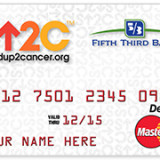
Fifth Third Bank this week announced the launch of the Fifth Third Stand Up to Cancer Debit MasterCard.  Stand Up To Cancer is a groundbreaking initiative that facilitates scientific collaboration to accelerate innovative cancer research and bring new therapies to patients quickly.  The card is now available by visiting any of the Bank’s more than 1,300 banking centers.

Stand Up To Cancer will receive $10 for each $25 annual fee associated with the Stand Up To Cancer Debit Card.  In addition, Stand Up To Cancer will receive $.0005 per net retail purchase made with the Stand Up To Cancer Debit Card.  From July 2013 to June 2016, Fifth Third is guaranteeing a minimum contribution of $400,000 in connection with this program.

“As a populist movement to accelerate the pace of research, Stand Up To Cancer depends on the contributions of countless individuals, no matter how large or small – ever precious penny adds up to make a real difference,” said Rusty Robertson, co-founder, Stand Up To Cancer and partner, Robertson Schwartz Agency.  We’re grateful to Fifth Third Bank for offering consumers a simple and convenient way to support research that’s focused entirely on helping patients.”

The card can be used anywhere Debit MasterCard is accepted.  Fifth Third Bank is the first card issuer to offer a Stand Up To Cancer payment card and says a Stand Up To Cancer credit card is also in the works.  “We are proud to work with Stand Up To Cancer to support the organization’s research and provide our customers a way to get involved in the fight against cancer,” said Julie Joseforsky, senior vice president and head of Bankcard for Fifth Third Bank.  “At Fifth Third we are committed to improving the lives and well-being of the communities we serve and are pleased to have found an innovative way to do so with a debit card – a payment form many of our customers are already using every day.”

For more information on Fifth Third Bank’s new Stand Up To Cancer Debit MasterCard, visit: www.53.com/SU2C

For more information on Stand Up To Cancer, visit: www.standup2canceer.org

For more on this story, visit:  http://www.marketwatch.com/story/fifth-third-bank-introduces-stand-up-to-cancer-debit-card-2013-06-12

Category: Best Low Fee Prepaid Cards

Millions of people are turning to prepaid debit cards as a smart alternative to carrying cash and writing checks. Almost anyone can qualify and they don’t require a credit check or a bank account.

Though they carry credit card logos and can be used anywhere a credit card is used, unlike a credit card, they do not offer a line of credit. The user can only spend the amount that has been loaded onto the card or placed into the account associated with the card.

There are dozens of debit cards on the market, many of them issued by the same bank, but fee structures are vastly different. Bestprepaiddebitcards.com has done all the research for you and provides comprehensive reviews to help you decide which card is best for you.


GO2bank Offers Overdraft Protection up to $300.

And build your credit with the GO2bank Secured Visa® Credit Card with no annual fee*, no credit check*, and no impact to your credit when you apply. (sponsor link)


  • Fifth Third Bank’s New ‘Stand Up to Cancer’ Debit Card Offering Drives Funding for Cancer Research

    Fifth Third Bank’s New ‘Stand Up to Cancer’ Debit Card Offering Drives Funding for Cancer Research

    Fifth Third Bank this week announced the launch of the Fifth Third Stand Up to Cancer Debit MasterCard.  Stand Up To Cancer is a groundbreaking initiative that facilitates scientific collaboration to accelerate innovative cancer research and bring new therapies to patients quickly.  The card is now available by visiting any of the Bank’s more than 1,300 banking centers.

    Stand Up To Cancer will receive $10 for each $25 annual fee associated with the Stand Up To Cancer Debit Card.  In addition, Stand Up To Cancer will receive $.0005 per net retail purchase made with the Stand Up To Cancer Debit Card.  From July 2013 to June 2016, Fifth Third is guaranteeing a minimum contribution of $400,000 in connection with this program.

    “As a populist movement to accelerate the pace of research, Stand Up To Cancer depends on the contributions of countless individuals, no matter how large or small – ever precious penny adds up to make a real difference,” said Rusty Robertson, co-founder, Stand Up To Cancer and partner, Robertson Schwartz Agency.  We’re grateful to Fifth Third Bank for offering consumers a simple and convenient way to support research that’s focused entirely on helping patients.”

    The card can be used anywhere Debit MasterCard is accepted.  Fifth Third Bank is the first card issuer to offer a Stand Up To Cancer payment card and says a Stand Up To Cancer credit card is also in the works.  “We are proud to work with Stand Up To Cancer to support the organization’s research and provide our customers a way to get involved in the fight against cancer,” said Julie Joseforsky, senior vice president and head of Bankcard for Fifth Third Bank.  “At Fifth Third we are committed to improving the lives and well-being of the communities we serve and are pleased to have found an innovative way to do so with a debit card – a payment form many of our customers are already using every day.”

    For more information on Fifth Third Bank’s new Stand Up To Cancer Debit MasterCard, visit: www.53.com/SU2C

    For more information on Stand Up To Cancer, visit: www.standup2canceer.org

    For more on this story, visit:  http://www.marketwatch.com/story/fifth-third-bank-introduces-stand-up-to-cancer-debit-card-2013-06-12

  • Reports Show Bank Customers Need More Protection From Debit Card Overdraft Fees

    Reports Show Bank Customers Need More Protection From Debit Card Overdraft Fees

    A report released this week by the Consumer Financial Protection Bureau shows bank customers need more protection from debit card overdraft fees.  The report focuses on overdraft fees banks charge customers when they overdraw their checking account with a debit or ATM card.

    Before mid-2010, when customers didn’t have enough money on their checking account to cover transactions, most banks would allow the purchase to go through and charge an overdraft fee.  This would result in multiple overdraft fees for the customer.  In 2009, the Federal Reserve adopted a new rule that prohibited banks from charging overdraft fees unless customers opted into an overdraft program in advance.

    The CFPB study found that not only did a large number of customers sign up for overdraft protection, but they continued to rack up fees.  The study also found customers who had been charged overdraft fees before the opt-in rule were more likely to opt in than those who had not been hit with overdrafts.  It also showed the more overdraft charges they had incurred before the rule, the more likely they were to opt in.  Customers who incurred at least one overdraft or bounced check fee in 2011 paid an average of $225 in overdraft fees that year.

    Banks say overdraft protection is a service some customers want and are willing to pay for.  Consumer groups say banks are luring customers into the program with confusing disclosures and marketing pitches.  “So-called ‘overdraft protection’ programs are really just a way for banks to bilk their most vulnerable customers with costly fees,” Consumers Union says in a press release.

    “We need to determine whether banks and credit unions are causing the kind of consumer harm that the federal consumer protections laws are designed to prevent,” said CFPB Director Richard Cordray.

    Consumers Union says the report “underscores the need for new reforms to protect customers from unfair checking account overdraft programs.”  It urges the bureau and other federal regulators to simplify disclosures of overdraft policies, require that overdraft fees be reasonable and proportional to the financial institution’s cost, limit the number of overdraft fees that can be charged per day and year and prohibit banks from processing daily transactions in a way that maximizes fees.  A bill sponsored by Rep. Carolyn Maloney, D-N.Y, would do many of those things including limiting fees o one per month and six per year.

    For more information on the CFPB Study of Overdraft Programs, visit:  http://files.consumerfinance.gov/f/201306_cfpb_whitepaper_overdraft-practices.pdf

    For more information on this article, visit:  http://blog.sfgate.com/pender/2013/06/11/bank-customers-still-racking-up-debit-card-overdraft-fees-report-says/

Credit and Debit Card Ratings