How to Choose a Prepaid Debit Card and Save Money in the Process

A  prepaid debit card is a prepaid debit card, right?  I mean, they all look pretty much the same and can be used the same places, right?  Well, not exactly… They are definitely very close in appearance and usage, but understanding their important features and fees and how they differ is the key to deciding which prepaid card, if any, to choose.


She spoke with the sort of energetic enthusiasm of someone who had just discovered gold, platinum or a shipwrecked pirate ship loaded with goodies off the coast.  In a casual coffee-break chat, a co-worker told me she uses prepaid debit cards to help manage their family’s spending.  Where it really got interesting was learning with that budgeting tool, she and her husband saved nearly $2,000 in only two months.

How Prepaid Debit Cards Work
Boiling it down to the most basic terms, here’s how most cards work. Users deposit money to their card account.  You may hear people speak of funding their card – or “loading” them, which is the most common term in the prepaid card world for depositing money via a direct deposit, wire transfer, PayPal or a variety of other means. And once the card is loaded, it works basically the same as a credit card, debit card or check. Cardholders can shop at any retailer or restaurant that accepts their card brand, go online to shop, or get cash through the checkout line or via ATM withdrawals. So what is the main difference, you may ask, from credit cards and debit cards linked to a checking account?   The key difference, the bottom line is that the users of prepaid cards cannot spend more money than what is loaded on the card. This means no NSF or non-sufficient funds fees!  NSF fees are the bane of the checking world.  For families or individuals attempting to run cash only households, prepaid debit cards are helpful for staying on budget and out of debt.

So… How Do You Choose the Best Prepaid Debit Card?
Well, here is the goal:  find the card that fits your needs and costs you the least to operate. In order to find the best card while saving your hard earned money, take a look at the following things to consider when selecting the best prepaid debit card for you, and you will be well on your way to learning how to choose a prepaid debit card.

Average Monthly Usage Charges: When you take into effect your usage and any recurring monthly fees, you  can be looking at an average cost from below $5  to up to $25 per month, so it pays to do your research.

S-A-V-E spelled out in scrabble letters over cash moneyFees on Purchases and Cash Withdrawals:  Look at the fee structure and how you will use your card for purchases and cash withdrawals.  We summarize this information on our Best Prepaid Debit Cards listing pages.  On the individual card review pages, we break this down into even more detail for you.  You can also find this information by doing a little bit of digging on the card-issuer’s website and looking at their Cardholder Agreement or a Fees breakout page.  Some websites make it really easy to find the fees and others, well, not so much.  That is why we collect that information for you at our website.  Our goal is to help you make your decision and save you time. 

Cash Loading Fees: Look at how you will load your card.  Things to consider are what are the local nearby resources or locations where you can easily and/or cheaply load your card.  This can include banks, credit unions, and retail stores that offer card loading opportunities.

Primary Purchases: Look at how and where you will spend on your card.  Most places take Visa and MasterCard and a lot of places, but not all, take American Express, for example.  You can do a quick inventory on where you shop or like to hang out and next time you are there, make a mental note of what cards they take.  If everywhere you go accepts American Express cards, there are some great cards from Amex that offer really low fees, such as the BlueBird card.  If most places you frequent only accept Visa and MasterCard, an Amex-branded card may not be quite as convenient.  You may feel it is worth it to pay a little more in fees for more convenient usage.

Cash Withdrawals:  Look at how and where you will get cash off your card.  These days, if you live near a store such as Wal-Mart or a grocery store, you can conveniently purchase your groceries and get a cash withdrawal at the checkout counter where they have the Point-of-Sale device (POS).  You enter what amount you want, enter your PIN and voila, the nice person behind the counter or automated checkout service delivers your newly acquired cash directly to you.


Add it All Up – Average Monthly or Annual Usage Charges:  Total it up and see what fees you are looking at on a monthly as well as an annual basis.  I know, I know.  I am asking you to do a bit of math, but it won’t hurt for long, and if done well and done correctly, you could save yourself quite a bit of money on a monthly and especially annual basis.  You know what they say, “No pain, no gain,” right?  We provide some standard measurements so you can see how cards rank against each other in terms of average monthly fees on the Best Prepaid Cards Listing pages, which should make it a lot easier. After you have done this exercise of looking at where you shop, plan to deposit money, get cash, etc. you can see how the various cards stack up for those typical fees.  The ones that offer the best savings on fees and most convenience or finds the best middle-ground for you, well, that is your card.  With these simple guidelines, you too, can answer the question: how to choose a prepaid card and save money in the process. Happy card shopping!


This article originally appeared on Debt Collection Answers.com.

BIO:

Shane Tripcony co-founded BestPrepaidDebitCards.com in March 2013 with Curtis Arnold, founder and CEO of CardRatings.com, a long-time consumer advocate in the credit area.  They saw a need in the marketplace to help educate consumers about the best deals in the prepaid debit and secured credit cards space and to expose high fees among those products.  Since launching the site, Shane has been blogging on personal finance topics and helping consumers improve their financial life through building or rebuilding their credit or saving money and budgeting with prepaid debit cards.

Author: Shane Tripcony

  • How to Choose a Prepaid Debit Card and Save Money in the Process

    How to Choose a Prepaid Debit Card and Save Money in the Process

    A  prepaid debit card is a prepaid debit card, right?  I mean, they all look pretty much the same and can be used the same places, right?  Well, not exactly… They are definitely very close in appearance and usage, but understanding their important features and fees and how they differ is the key to deciding which prepaid card, if any, to choose.


    She spoke with the sort of energetic enthusiasm of someone who had just discovered gold, platinum or a shipwrecked pirate ship loaded with goodies off the coast.  In a casual coffee-break chat, a co-worker told me she uses prepaid debit cards to help manage their family’s spending.  Where it really got interesting was learning with that budgeting tool, she and her husband saved nearly $2,000 in only two months.

    How Prepaid Debit Cards Work
    Boiling it down to the most basic terms, here’s how most cards work. Users deposit money to their card account.  You may hear people speak of funding their card – or “loading” them, which is the most common term in the prepaid card world for depositing money via a direct deposit, wire transfer, PayPal or a variety of other means. And once the card is loaded, it works basically the same as a credit card, debit card or check. Cardholders can shop at any retailer or restaurant that accepts their card brand, go online to shop, or get cash through the checkout line or via ATM withdrawals. So what is the main difference, you may ask, from credit cards and debit cards linked to a checking account?   The key difference, the bottom line is that the users of prepaid cards cannot spend more money than what is loaded on the card. This means no NSF or non-sufficient funds fees!  NSF fees are the bane of the checking world.  For families or individuals attempting to run cash only households, prepaid debit cards are helpful for staying on budget and out of debt.

    So… How Do You Choose the Best Prepaid Debit Card?
    Well, here is the goal:  find the card that fits your needs and costs you the least to operate. In order to find the best card while saving your hard earned money, take a look at the following things to consider when selecting the best prepaid debit card for you, and you will be well on your way to learning how to choose a prepaid debit card.

    Average Monthly Usage Charges: When you take into effect your usage and any recurring monthly fees, you  can be looking at an average cost from below $5  to up to $25 per month, so it pays to do your research.

    S-A-V-E spelled out in scrabble letters over cash moneyFees on Purchases and Cash Withdrawals:  Look at the fee structure and how you will use your card for purchases and cash withdrawals.  We summarize this information on our Best Prepaid Debit Cards listing pages.  On the individual card review pages, we break this down into even more detail for you.  You can also find this information by doing a little bit of digging on the card-issuer’s website and looking at their Cardholder Agreement or a Fees breakout page.  Some websites make it really easy to find the fees and others, well, not so much.  That is why we collect that information for you at our website.  Our goal is to help you make your decision and save you time. 

    Cash Loading Fees: Look at how you will load your card.  Things to consider are what are the local nearby resources or locations where you can easily and/or cheaply load your card.  This can include banks, credit unions, and retail stores that offer card loading opportunities.

    Primary Purchases: Look at how and where you will spend on your card.  Most places take Visa and MasterCard and a lot of places, but not all, take American Express, for example.  You can do a quick inventory on where you shop or like to hang out and next time you are there, make a mental note of what cards they take.  If everywhere you go accepts American Express cards, there are some great cards from Amex that offer really low fees, such as the BlueBird card.  If most places you frequent only accept Visa and MasterCard, an Amex-branded card may not be quite as convenient.  You may feel it is worth it to pay a little more in fees for more convenient usage.

    Cash Withdrawals:  Look at how and where you will get cash off your card.  These days, if you live near a store such as Wal-Mart or a grocery store, you can conveniently purchase your groceries and get a cash withdrawal at the checkout counter where they have the Point-of-Sale device (POS).  You enter what amount you want, enter your PIN and voila, the nice person behind the counter or automated checkout service delivers your newly acquired cash directly to you.


    Add it All Up – Average Monthly or Annual Usage Charges:  Total it up and see what fees you are looking at on a monthly as well as an annual basis.  I know, I know.  I am asking you to do a bit of math, but it won’t hurt for long, and if done well and done correctly, you could save yourself quite a bit of money on a monthly and especially annual basis.  You know what they say, “No pain, no gain,” right?  We provide some standard measurements so you can see how cards rank against each other in terms of average monthly fees on the Best Prepaid Cards Listing pages, which should make it a lot easier. After you have done this exercise of looking at where you shop, plan to deposit money, get cash, etc. you can see how the various cards stack up for those typical fees.  The ones that offer the best savings on fees and most convenience or finds the best middle-ground for you, well, that is your card.  With these simple guidelines, you too, can answer the question: how to choose a prepaid card and save money in the process. Happy card shopping!


    This article originally appeared on Debt Collection Answers.com.

    BIO:

    Shane Tripcony co-founded BestPrepaidDebitCards.com in March 2013 with Curtis Arnold, founder and CEO of CardRatings.com, a long-time consumer advocate in the credit area.  They saw a need in the marketplace to help educate consumers about the best deals in the prepaid debit and secured credit cards space and to expose high fees among those products.  Since launching the site, Shane has been blogging on personal finance topics and helping consumers improve their financial life through building or rebuilding their credit or saving money and budgeting with prepaid debit cards.

  • Consumer Financial Protection Bureau’s Proposed Prepaid Card Regulatory Changes Inspires Industry Response

    Consumer Financial Protection Bureau’s Proposed Prepaid Card Regulatory Changes Inspires Industry Response

    When the Consumer Financial Protection Bureau (CFPB) was created in 2010, nobody expected it to play nice with the financial services industry. Authorized as part of the Dodd-Frank legislation, the CFPB was tasked with protecting consumers from predatory lending and other Wall Street abuses that spawned the Great Recession. From the very start, the financial services industry and its allies in Congress resisted the formation of the CFPB, and even successfully torpedoed the choice of now-Senator Elizabeth Warren to lead the agency. Now, a new battle is about to commence: the CFPB is gunning for prepaid regulatory changes.


    In the handful of years since the CFPB began its oversight of the financial services industry, it has scored a number of consumer-friendly victories. Largely unheralded by the media, the CFPB has managed to do everything from force credit card issuers to be more transparent about the interest charges related to balance transfers to handling hundreds of thousands of consumer complaints. Red Boxer (CFPB) Squares Off with Blue Boxer (NBPCA)More recently, the CFPB has placed the prepaid debit card industry in its crosshairs and, not coincidentally, triggered concern and angst from the Network Branded Prepaid Card Association (NBPCA), an industry trade group.

    The proposals by the CFPB and the responses from the NBPCA are a classic illustration of the inherent adversarial relationship between regulators charged with protecting the interest of consumers and industry eager to help its businesses remain as profitable as possible. For example:

    • The CFPB would like to apply the more rigorous regulations that apply to credit cards to certain prepaid products, especially those that allow customers to overdraft or overdraw their accounts. This application of what is known as the Federal Reserve’s Regulation Z to certain prepaid cards is opposed by the NBPCA, which says it’s the sort of restrictive regulation that limits options for consumers and may even result in customers opting for riskier products.
    • The CFPB has proposed expanding the definition of what a prepaid debit card is, the result of which would be more an expansion of the number of products subject to government regulations. The NBPCA, by contrast, wants to limit the definition to only primary account transactions, which take the place of a debit card tied to a checking account.
    • There is some overlap in what the industry and the government want to see in the realm of disclosure about fees. Both the CFPB want more disclosure, though the industry group wants a single template for disclosure while the government has proposed a number of them.
    • Even the speed with which the government’s rules would go into effect is a matter of debate. The CFPB has said nine months is plenty of time for prepaid card issuers to adapt to the new rules while the NBPCA believes it will take between 18 and 24 months.

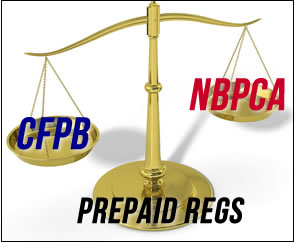
    The final determination about the rules that will govern prepaid cards in the future is still being hashed out. Scales of Justice: CFPB vs NBPCAAnd while it would be easy to decry this sort of back-and-forth as yet another instance of Washington paralysis, there’s a case to be made that this process is working just as it should. No industry wants to bear the increased time and money it requires to comply with new rules and regulations, especially when it comes at the cost of profits. But this adversarial relationship between the prepaid industry and the CFPB could and should result in a range of protections that ensure consumers aren’t victimized. At the same time, the input of industry should ensure that whatever new regulations get enacted don’t drive the efficiency and consumer value out of prepaid debit cards.

    If both happen, then consumers will have more confidence in prepaid cards generally, which is a win for both the CFPB and the NBPCA.


Credit and Debit Card Ratings